Commercial Roll-Up Doors
Irving Roll-Up Doors
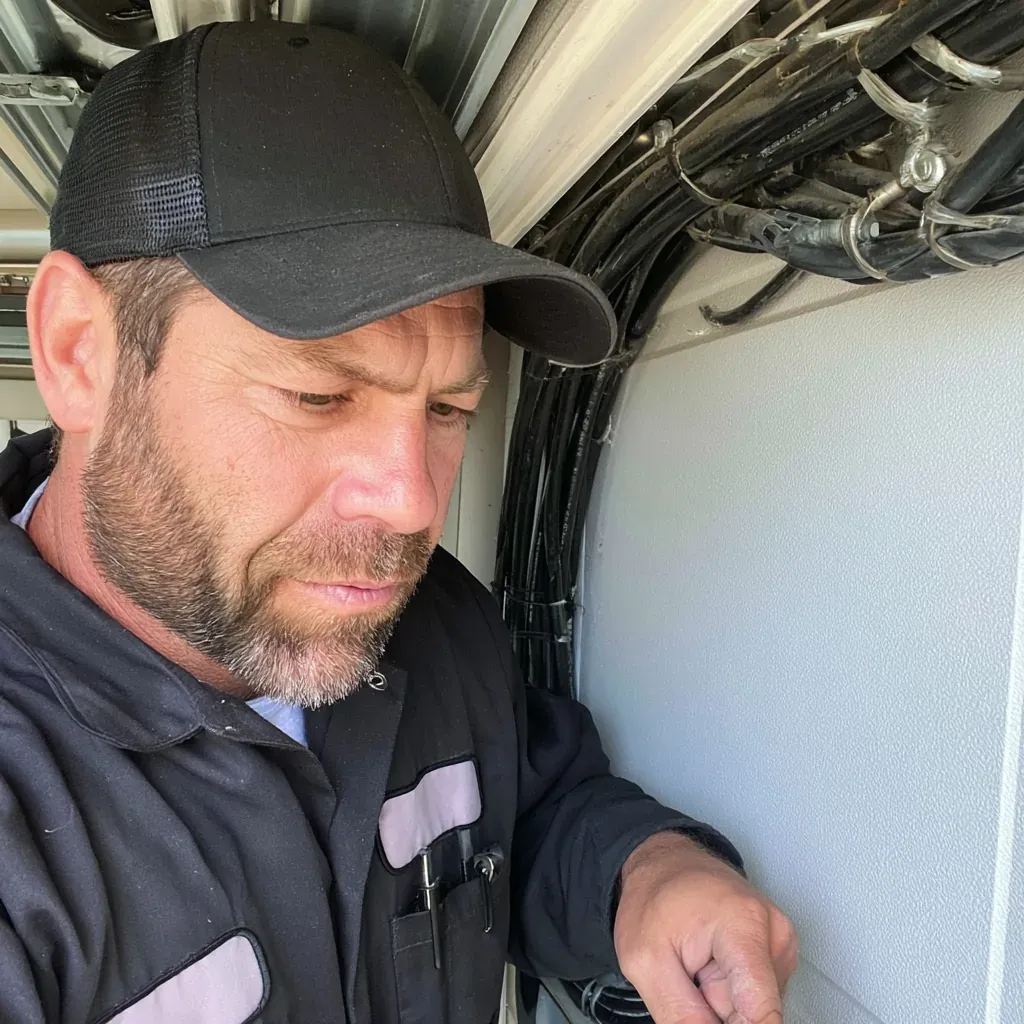
One multi-site account, billed and documented separately for every door across the portfolio.
Property managers with buildings across Irving, including Las Colinas and Valley Ranch, can run one multi-site account with a set response time, a work order for every visit, and billing kept separate by unit.
A property manager covering Las Colinas towers and a Valley Ranch garden complex is not measuring panel style against a leasing photo. The question is whether a fault called in from a building near Lake Carolyn gets a technician out before it becomes a liability on a unit someone is trying to show. Downtime on a shared entrance or a resident's assigned bay is the concern, not curb appeal, and Irving's stock spans both.
Irving's stock splits into build waves that a managed portfolio usually straddles. Older sections near the Heritage District and Irving Heights still run original extension springs, while Las Colinas towers and Valley Ranch complexes came up decades later on different hardware entirely. A manager tracking a spread this wide cannot treat one repair date as the schedule for the whole account, since a spring installed in the 1980s and one installed in 2005 do not fail on the same clock.
Heat and clay movement are the shared variable across an Irving portfolio, not weather in the northern sense. Slab-on-grade construction across the city shifts with expansive clay through summer, and a track bolted to a frame that has moved even slightly binds a door long before anyone notices a dent. A unit near Cottonwood Valley and one near Northgate face the same slab behavior, just on different timelines depending on drainage and age.
A portfolio spread across Las Colinas, Valley Ranch and the streets near MacArthur Boulevard moves faster through one intake than through each site handler dialing around separately. A work order goes in once, naming the address, the door and what it's doing, and the licensed pros we connect you with take it from there without a manager relaying the same details twice to two different callers.
Response time depends on what the door is holding closed and who's stuck behind it. A leasing office near Toyota Music Factory wants a jammed door cleared before a prospective tenant tour, while a resident locked out of a Valley Ranch garage at night has a different kind of urgency. Neither gets solved by a fixed promise; both get solved by naming the stakes when the call goes in.
| Door Type | Cycle Rate | Typical Problem |
|---|---|---|
| Who reports it | One owner, one door | One manager, many properties |
| Account setup | Paid on the spot | Multi-site account, per-unit invoices |
| Site access | Owner meets the tech | Access contact agreed before the visit |
| Door records | Usually not kept | Asset register entry per door |
| Response time | Timing agreed for each Irving address | Set once for the account |
| Scope of visit | One door, one fix | Several buildings on one work order |
| Hinge and track wear | Common on units near Story Road frontage | Logged per unit ahead of turnover |
| Repeat service call | Same door, new lease, same complaint again | Attached to the unit file so history isn't lost |
Scheduling across Las Colinas and Valley Ranch together means one visit plan instead of two uncoordinated trips crossing SH 114 or the President George Bush Turnpike for a single afternoon of work. A manager holding both addresses on one account can group calls by proximity rather than by which tenant phoned in first, which shortens the wait on both ends.
That invoice earns its keep when it names the part, not just the charge. A spring replaced on a door near Hackberry Creek should list its size and cycle rating, and a cable or roller swap should say which one failed and why, since Irving's older extension springs and slab-on-grade movement wear differently door to door. A manager reading five invoices a month needs to tell them apart at a glance.
Ask the company doing the work for current insurance details and a written line item tied to the property and opening. Clear records make later review possible without guessing which door received the repair.
Tenant coordination is a separate job from fixing the door. Someone renting near Cottonwood Valley or in a Las Colinas high-rise doesn't need to hear about torsion versus extension springs or what a photo-eye sensor does. They need a window of time and a knock, told to them plainly, so the repair doesn't turn into a surprise visit that catches them mid-shower or mid-meeting.
A vacant unit between tenants changes who notices the problem, not whether the door still matters. Nobody near Royal Lane or Walnut Hill Lane is calling about a door stuck half-open on an empty unit, which means a manager has to catch it through inspection rather than a complaint. An Irving portfolio with any vacancy at all needs that inspection built into turnover, not left to chance.
Once an Irving portfolio includes several doors, an address-by-address equipment record becomes useful. Logging the opener model, drive style, and most recent spring work gives each opening a clear maintenance history instead of turning every call into a fresh investigation.
Belt drive suits an attached unit where a resident sleeps or works close to the mechanism, since it runs quieter through the months Irving windows stay open before the summer heat sets in. Chain drive still holds up on older doors and detached work areas where noise matters less, including some of the aging central-Irving stock a portfolio might carry alongside its newer Las Colinas buildings.
An asset register earns its place once a portfolio holds more than a handful of doors scattered between Valley Ranch and the Heritage District. A plain list by address, opener type, spring size and last service date turns a phone call about a broken door into something the manager can answer in one look, rather than a guess made while standing in a parking structure near Lake Carolyn.
A gated Las Colinas complex or a Valley Ranch community with a coded entry raises the same problem for property managers: the tech can't reach the door to close the work order. Leave gate codes or a callbox number on the account itself, not just one lease file, so any visit under that multi-site account gets in without a phone tag delay. Note the access method in the asset register per unit, since the next tech, and the next response time, depends on it being right.
One account can hold every Irving address a manager oversees, from a Las Colinas office park to a rental near Plymouth Park, so a work order goes in once per fault instead of a fresh phone call for every site. That single thread carries the response time expectation, the access notes, and the billing detail through to the licensed pros we connect you with, without a manager repeating the property's history to a new voice each time.
Sun on a west-facing panel all afternoon and a sudden hailstorm behind it stress metal in two directions the same week. Panels warp slightly, fasteners loosen, and a track that looked fine in spring starts binding by summer, usually right where the sun hit longest and the door works hardest.Grapevine, Hackberry Creek and Heritage District. A door that reverses before it touches the floor is telling you something specific: a safety sensor is misaligned, blocked, or the travel limit drifted. In Irving this shows up after a bump, a heat cycle, or months of dust settling on the lenses near the slab.
A door that has run smoothly for years can start binding after one hard freeze exposes a spring already weakened by ordinary cycling. The cold does not cause the wear, it just reveals what heat and use had already started. Checking track alignment first keeps a simple spring swap from turning into a bigger repair.This figure assumes a standard attached garage door on an Irving home, single car, common sizing. A commercial bay serving offices off MacArthur Boulevard, an oversized door in Valley Ranch, or a detached second garage near Campion Trail will shift the estimate once the pros see the opening and track condition in person. Full guide bands are on the pricing guide, and the commercial overview covers how a scheduled program works.
Irving Roll-Up Doors
Irving Commercial
Commercial Doors
Submit through whatever intake the management office already runs, naming the property and the specific unit or suite affected. That request reaches the licensed pros we connect you with, who treat a stuck roll-up at a Las Colinas office differently than a bent track on a Valley Ranch garage, since the fault and the door type change what gets scheduled first.
Access gets arranged before the technician is on site, not worked out at a locked gate. That might mean a code left for a Las Colinas parking structure, a staffer meeting the licensed pros we connect you with at a Valley Ranch entrance, or a note on the work order about which building near Lake Carolyn the door is on. Settling it ahead of the visit keeps the appointment from stalling at the curb.
No repair cost is fixed in advance, since a cracked panel on a Las Colinas office door and a worn roller on a Northgate rental building call for different parts and labor. What helps a manager budget is naming the building, the door number and the fault when calling, so the estimate reflects that specific unit rather than a general guess.
Yes. Each door on an Irving account can carry its own record apart from the others: opener and drive type, spring size, and what was addressed at each visit. For a portfolio running units from Valley Ranch to Las Colinas, that record is what lets a manager answer a tenant's question about a specific door without pulling every invoice the account has ever generated.
Set up one account covering every address in the portfolio, with a work order and response time agreed on before a door needs attention.
Call (972) 961-2237