Extension Springs and Safety Cables in Irving, TX
How stretch springs lift older Irving garages, and what the safety cable is guarding against.
An extension spring lifts a garage door by stretching along the horizontal track, pulling through a pulley system rather than twisting on an overhead shaft. It needs a safety cable through its coils and suits older or low-headroom garages where a torsion shaft will not fit.
How the Stretch Lifts the Door
Older Irving homes near the Heritage District or Plymouth Park often still carry extension springs instead of the torsion type. Mounted above each horizontal track, the spring lengthens as the door drops and pulls back as it rises, storing the lifting force in that stretch. A door on a slab-on-grade foundation that has shifted with expansive clay puts uneven strain on both springs, so one side can wear or fail well before its partner.
Each extension spring hangs above a horizontal track and connects through a pulley near the front of that track, with a lift cable running back to the bottom bracket on the door. Open the door in Irving and the spring stretches to its longest point; closed, it relaxes. The pulley changes the direction of pull so a spring mounted flat overhead can still draw the bottom corner of the door upward as it travels the track.
Tell the two apart by watching the spring during travel rather than counting how many there are. A torsion spring stays fixed to a shaft above the opening and only the shaft rotates, while an extension spring visibly lengthens and shortens along the track with every open and close in a garage on Rochelle Road or anywhere else in Irving.
The Job of the Safety Cable
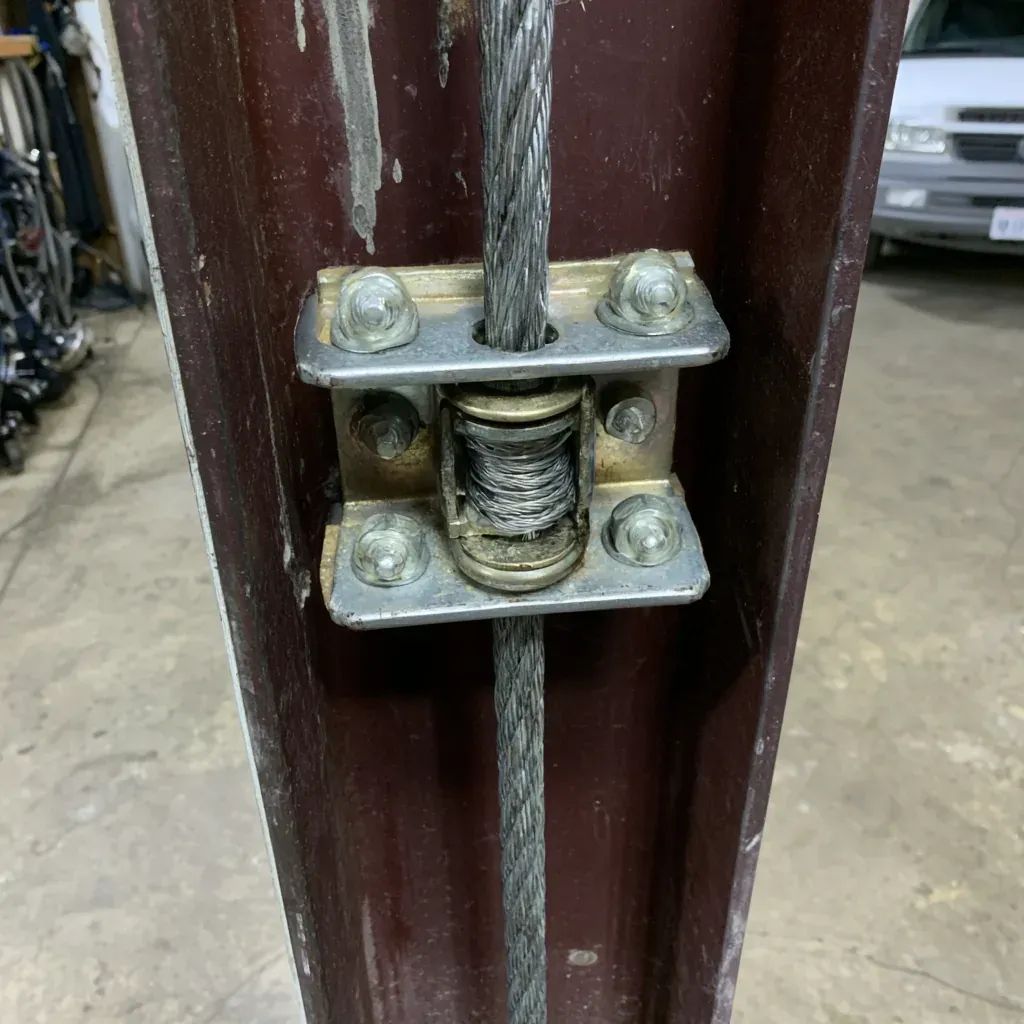
The safety cable runs through the center of an extension spring, fastened at each end to the bracket rather than to the spring coils. If the spring snaps, the broken halves stay strung on that cable instead of dropping onto a car roof or a driveway underneath. On homes around University Hills and Irving Heights with older single-car openings, the door still lifts off exposed extension springs mounted above the track, which is exactly where a missing or frayed cable matters most.
An extension spring holds tension the entire time the door sits closed, then stretches further as the door travels down and lets go as it rises. That cycle repeats every time the door is used, and steel fatigues from it. When a coil finally snaps under that stretch, the two halves do not settle quietly onto the track. They release stored energy fast, in whatever direction the broken end is pointed.
A cable through the coils keeps that broken spring, and the hooks bolted to its ends, tethered to the bracket instead of loose in the garage. Homes around Plymouth Park and Irving Heights old enough to still run extension hardware were mostly built before this cable was required equipment, so a pro checking one of these doors looks for whether a cable was ever added, not just whether the spring looks sound.
Extension vs. Torsion in Feel
Torsion and extension springs give different warnings before they fail, which changes what an Irving homeowner notices first. A torsion spring on a shaft-mounted opener usually loses lift gradually over weeks as the coil fatigues, or lets go with a loud bang that echoes through an attached garage near Lake Carolyn or the Mandalay Canal Walk. An extension spring tends to fail faster and more visibly, since the stretched coil is already carrying the door's weight in the open.
Extension hardware also wears in places torsion systems skip entirely. The pulley wheel can bind or wear a groove into its bracket over the years, and each S-hook connecting spring to cable is a bend in the steel that loosens and fatigues with repeated flexing. A torsion shaft has none of these small connected parts, which is part of why an extension system tends to need more frequent adjustment.
Deciding on a Conversion
Conversion swaps the track-mounted pulleys and cables for a single torsion shaft centered above the opening, and whether it fits comes down to the clearance available there. Detached garages and older single-car openings near Irving Heights and Downtown Irving sometimes have too little clearance above the door for a torsion shaft and its end bearing plates, which is why low headroom is the first thing worth measuring before assuming conversion is possible.
Where the clearance exists, a torsion shaft trades exposed, stretched coils along the track for one that sits still and turns instead, removing the pulley, the S-hook and the cable run that extension hardware depends on. Garages in Valley Ranch or Las Colinas built with taller framing tend to have room for the swap; older, lower-ceiling garages near Cottonwood Valley or Bear Creek sometimes do not, and that is a measurement question before it is a cost question.
Extension Spring Basics
- An extension spring runs along each horizontal track and pulls tight as the door lowers, storing energy to help lift it back up. A torsion setup instead winds a single spring on a shaft centered above the opening, using a different pulling motion entirely to move the door.
- An extension spring stretches overhead along the track, unlike a torsion spring's twisting shaft, so headroom needs and cycle life differ. A frayed extension spring can whip loose under tension; a properly anchored safety cable keeps that broken coil confined near the track instead of dropping free.
- Central Irving streets near Irving Heights and Plymouth Park still carry the older single-car and narrow two-car openings most likely to run extension springs instead of a torsion shaft.
- These garages kept extension springs because the header above the opening never had the clearance a torsion shaft and its end brackets need to sit level and centered.
- A torsion conversion isn't a spring-for-spring swap. A shaft, bearing plates, and drums replace the track hardware, and the header bracket layout changes with them.
- The S-hook or pulley bracket wears from the cable riding over it thousands of times and can fail on its own, with the spring coil still intact, so a full check covers both parts.
Frequently Asked Questions
Do any Irving homes still use extension springs?
Yes, mainly on older single-car garages in central Irving, including some near Downtown Irving and the Heritage District, where the opening predates common torsion-shaft mounting. Larger two-car doors going up around Valley Ranch and Cottonwood Valley in recent decades typically arrived with torsion hardware instead. Age alone does not tell you which one sits above a given track, so the pros we connect you with check the bracket before quoting anything.
What is that cable running through my spring?
It threads through the coil's middle and fastens at both ends to the structure, separate from the spring's own mounting hardware. Under normal use it holds no weight and simply sits there. If a coil lets go or snaps, the cable is what keeps flying metal from crossing the garage, which matters in narrow bays common around University Hills and older Irving Heights lots.
Should I switch my extension springs to torsion?
Torsion springs mount on a shaft and do not stretch into the garage, so headroom and layout matter more than preference. On a low-headroom opening near Downtown Irving or an older University Hills garage where the shaft has nowhere to sit, extension hardware with a properly installed safety cable can be the sounder call than forcing a conversion the space cannot fit.
Want your safety cables inspected?
The licensed pros we connect you with can inspect extension spring hardware or price a torsion conversion in Irving.
Call (972) 961-2237