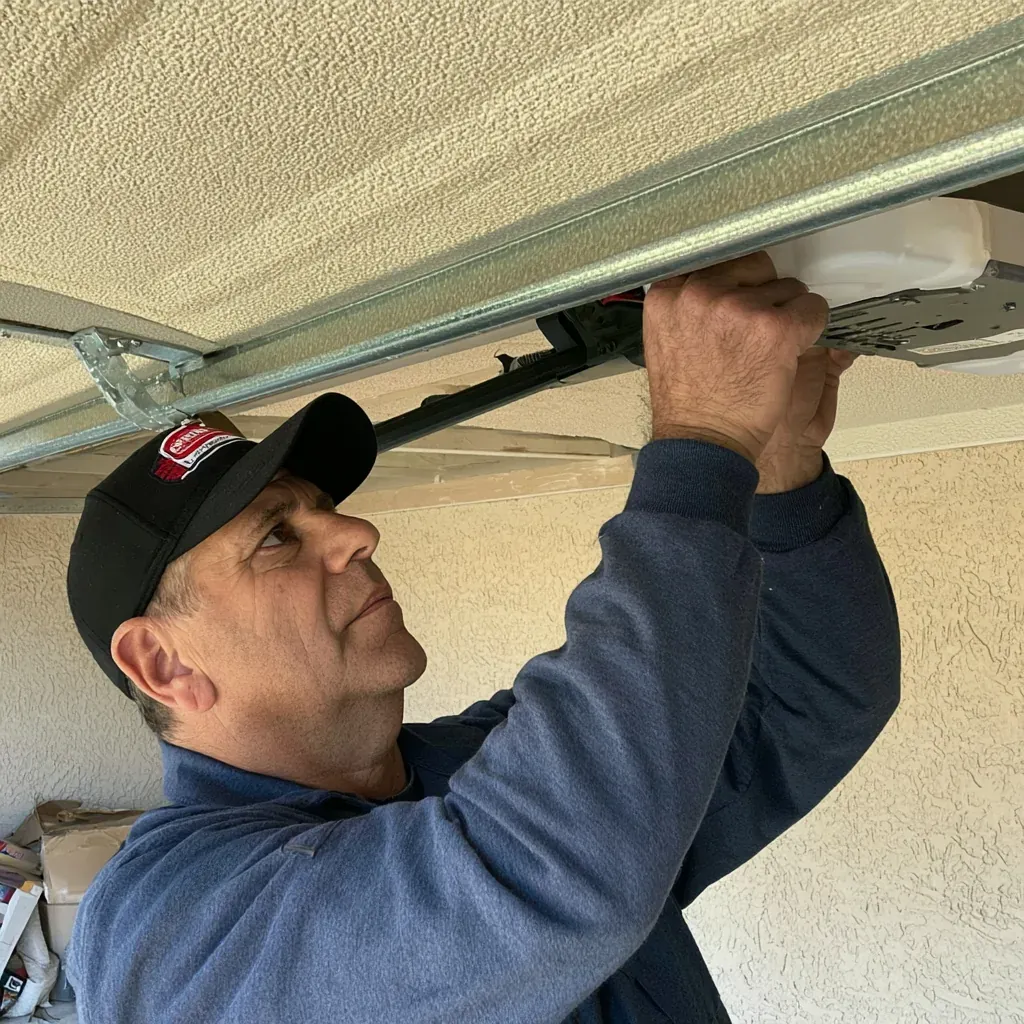
Somebody standing in front of a dead or aging opener in Irving usually starts with a brand name, because that's what's printed on the housing. LiftMaster, Chamberlain and Genie all sell residential openers sold through different channels, and the question is less about which logo is better and more about drive type, rolling code security, and whether replacement parts will still be available in a few years when a gear or circuit board wears out.
Same Parent, Different Channels
Homeowners in Irving often shop by brand name first, since LiftMaster and Chamberlain badges sit on openers all over Las Colinas and Valley Ranch garages, and Genie shows up plenty in the older sections near Irving Heights. The three share more engineering than most buyers realize; several models come from related manufacturing lines and use comparable drive systems. What actually separates them day to day is rolling code security, the app ecosystem tied to the motor head, and whether replacement parts sit on a shelf somewhere local or take a special order.
Chain, Belt Or Screw Drive
Drive type matters more day to day than the badge on the unit. Chain drives are common on older Irving garages and tend to be louder, which matters in homes where the garage sits under a bedroom in Irving Heights or Plymouth Park. Belt drives run quieter and are common across all three brands' mid and upper lines. Screw drives need less adjustment over time but can slow down when summer heat thickens the lubricant inside the rail.
What Rolling Code Actually Does
All three brands now build openers around rolling code, which changes the transmitter's numeric sequence on every use so a copied signal from an old universal clicker will not open the door twice. It matters most for Las Colinas apartments and Cottonwood Valley homes with shared parking, alleys or visitor lots, where an old fixed-code remote left in a sold car or a former tenant's hand is a real access gap, not just a compatibility footnote.
Where Parts Get Harder To Find
Parts availability is where the three brands actually diverge for a homeowner making a repair decision instead of a full replacement. LiftMaster's dealer network generally keeps circuit boards, gear kits and sensor pairs in supply for a long run of models. Genie parts are sold through its own retail and online channels but can be harder to match to an exact model number. Chamberlain overlaps heavily with LiftMaster parts since the internal hardware is often shared.
Heat Load On Plastic Gears
Heat exposure changes how these differences play out in Irving specifically. A west-facing garage along Story Road or MacArthur Boulevard that gets full sun most of the afternoon puts real stress on plastic drive gears and circuit board components regardless of brand. A gear that strips or a logic board that fails after a few summers isn't necessarily a bad unit, it's the byproduct of consistent heat load on a plastic part, and this is where parts availability decides how simple the fix is.
Safety Sensors Across All Three
Photo-eye sensors and the auto-reverse function are governed by UL 325, the safety standard covering entrapment protection on residential openers, and all three brands build to that standard on current models. What differs is how each brand implements the self-test and how forgiving the alignment tolerance is. A sensor pair that's slightly out of alignment after a bump from a car or bike will read as a fault regardless of which brand made it.
Smart Features And App Support
Smart features split along similar lines. LiftMaster's app ecosystem tends to integrate more broadly with third-party smart home platforms, and its higher-tier units often add camera or intercom options aimed at properties in Las Colinas or Valley Ranch where remote monitoring gets more use. Chamberlain's app covers most of the same ground on comparable models. Genie's connected line uses its own app and works through a separate bridge accessory rather than a built-in module.
Commercial Doors Are A Different Category
None of the three brands is inherently a better fit for a commercial application near DFW International Airport or the office towers of the Las Colinas Urban Center. Commercial sectional and roll-up doors are sized by opening, curtain weight and cycle count, and the opener that suits that load is a different product line entirely from any residential model these three brands sell for a house in Cottonwood Valley.
Matching Horsepower To Door Weight
Wind count matters more than any single brand's rated cycle life. A Heritage District household running the door twice a day sees a slower climb than a Las Colinas home with a home office, deliveries and two commuters passing through, or a commercial roll-up near the airport corridor cycling all shift. Heat from a west-facing steel door in an unvented Irving garage adds its own strain on seals and lubricant, so two identical openers in different driveways rarely age the same way.
What To Ask Before Installation
Texas has no statewide license naming garage door installers, so nothing exists to verify by number before a technician opens a Genie or LiftMaster unit in a Cottonwood Valley driveway. What can be checked is whether the person carries liability coverage, will put the brand, model and part numbers on paper before starting, and states plainly how long the replacement motor or gear set is covered once installed near Belt Line Road or anywhere else in the county.
What Actually Fails First Here
None of this makes one brand the obvious winner for every driveway in Irving. It means the right choice depends on the drive type suited to where the garage sits in the house, how easily parts get replaced years down the line, and whether the horsepower rating actually matches the door. That's a narrower set of questions than a brand name suggests, and it's what decides whether a new opener is a quiet fix or a repeat problem.
Dealing with this in your home?
One failure keeps repeating on Irving service calls without folding neatly into a general list. Heat cycling through a Las Colinas garage warps track hardware over years, while an older Heritage District door often reveals a spring the original installer undersized. Age and installation choice, not neglect, usually explain it.